
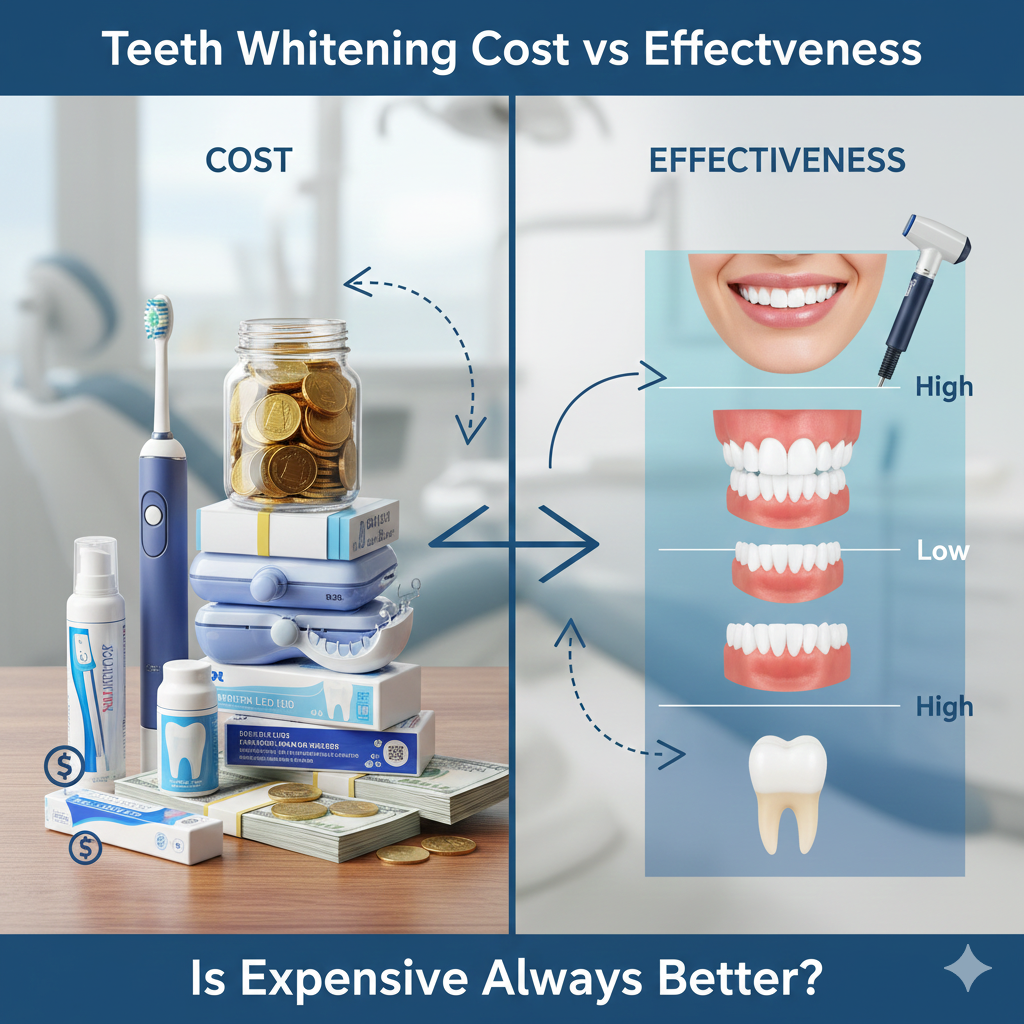
When it comes to enhancing your smile, the market is saturated with options ranging from ten-dollar drugstore strips to thousand-dollar laser treatments. This vast price discrepancy often leaves consumers wondering if a higher price tag truly guarantees a more radiant result. Understanding the relationship between teeth whitening cost and effectiveness is essential for anyone looking to invest in their appearance without wasting money on empty promises.
The Spectrum of Whitening Solutions
The quest for whiter teeth generally falls into two categories: over-the-counter (OTC) products and professional clinical treatments. OTC options include whitening toothpastes, rinses, strips, and generic tray systems. These are mass-produced and designed for a “one size fits all” application. Because they are sold without professional supervision, the concentration of active bleaching agents—usually hydrogen peroxide or carbamide peroxide—is kept low to prevent chemical burns or extreme sensitivity.
Conversely, professional treatments are administered by licensed dentists. These procedures utilize high-concentration bleaching gels that are often activated by specialized lights or lasers. The immediate environment is controlled; your gums are shielded, and the application is precise. Naturally, the logistical requirements of a dental office lead to the higher teeth whitening cost of professional procedures, but this investment covers more than just the bleach itself.
Analyzing the “Expensive is Better” Logic
In many industries, price correlates directly with quality. In teeth whitening, this correlation exists but is not always linear. To determine if expensive is “better,” we must define what “better” means: speed, safety, or longevity.
If “better” means achieving results in a single sixty-minute session, then expensive professional whitening wins decisively. OTC strips may take two weeks of daily application to achieve the same brightness that a dentist can produce in an hour. This efficiency is powered by the chemical potency allowed only in clinical settings.
However, if “better” is defined by the final shade of white achieved over time, the gap narrows. Clinical studies suggest that high-quality at-home strips used consistently for several weeks can eventually reach a level of brightness comparable to in-office treatments. The trade-off is time and discipline. The expensive option buys you immediacy.
The Hidden Value of Professional Supervision
One of the primary reasons for the price hike in dental offices is the preparatory work. Before whitening, a dentist examines your teeth for underlying issues. If you have “internal” staining caused by medication or trauma, topical bleaches—regardless of price—will fail. Furthermore, whitening agents do not change the color of crowns, veneers, or composite fillings.
An expensive professional consultation prevents the frustration of spending money on a treatment that physically cannot work on your specific dental work. When you pay for a professional procedure, you are paying for a diagnostic guarantee. This prevents the “trial and error” spending cycle that often plagues those who rely solely on cheap retail products.
Safety and the Cost of Error
Safety is where the price difference becomes most justifiable. Low-cost whitening kits often use generic trays that do not fit the unique contours of your mouth. This allows the bleaching gel to leak onto the soft tissues of the gums, causing “blanching” or chemical irritation.
Professional systems use custom-fitted trays or protective barriers. While this increases the initial price, it significantly reduces the risk of long-term tooth sensitivity and gum recession. For individuals with thin enamel or pre-existing sensitivity, the “expensive” route is often the only safe route. In this context, the higher cost acts as insurance against dental pain and potential damage to the tooth structure.
Effectiveness vs. Maintenance
A common misconception is that an expensive treatment lasts forever. In reality, the effectiveness of any whitening procedure is at the mercy of your lifestyle. Coffee, red wine, tobacco, and dark berries will restain your teeth regardless of whether you spent $20 or $2,000 on whitening.
Budget-conscious consumers often find that a “hybrid” approach is most effective. They might invest in one professional treatment to reach their goal shade quickly, then use more affordable, lower-concentration products for monthly maintenance. This strategy balances the high initial effectiveness of clinical work with the cost-efficiency of OTC products.
Breaking Down the Ingredients
To understand why prices vary, one must look at the chemistry. Hydrogen peroxide is the gold standard for whitening. Retail strips usually contain 6% to 10% concentration. In-office gels can reach up to 40%. The higher the concentration, the faster the oxygen molecules break the bonds of the discolored molecules within your enamel.
The expensive treatments often include desensitizing agents like potassium nitrate or fluoride within the whitening gel. These additives increase production costs but ensure the user experience is comfortable. Cheap products often omit these “comfort” ingredients to keep the price point low, which is why users frequently report “zingers” or sharp pains during the process.
The Role of Technology: Lights and Lasers
Many high-end dental offices offer LED or laser-accelerated whitening. These technologies are marketed as the pinnacle of teeth whitening effectiveness. While the light itself does not whiten teeth, it acts as a catalyst to speed up the chemical reaction of the peroxide.
Research on the necessity of these lights is mixed. Some studies show they provide a slight edge in speed, while others suggest the peroxide does the bulk of the work on its own. If you are paying a premium specifically for “laser” whitening, you are largely paying for the reduction in chair time. If you have the patience to sit for a slightly longer session without the light, you can often achieve the same results for a lower price point.
Customization and Longevity
Custom-fitted trays provided by a dentist represent a middle ground in the cost-effectiveness debate. These are more expensive than store-bought kits but cheaper than in-office laser sessions. Because the trays are molded specifically to your teeth, they ensure even distribution of the gel and minimize contact with the gums.
These trays are a one-time investment. Once you own them, you only need to purchase inexpensive gel refills from your dentist. Over a five-year period, this “expensive” initial purchase often proves to be more cost-effective and successful than buying dozens of disposable strip kits that provide inconsistent results.
When Expensive Isn’t Necessary
Is expensive always better? Not necessarily. If you have naturally bright teeth and only wish to remove minor surface stains from tea or coffee, a professional treatment might be overkill. A high-quality whitening toothpaste with silica and a low-percentage peroxide strip can effectively manage surface-level stains (extrinsic stains) for a fraction of the cost.
However, for deep, intrinsic staining that has accumulated over decades, the “cheap” route is frequently a waste of money. The concentration is simply not high enough to penetrate the dentin and alter the tooth’s internal color. In these cases, the expensive option is the only effective option.
Final Considerations on Value
The “value” of teeth whitening is subjective. It depends on your budget, your timeline, and your biological response to bleach. While the higher teeth whitening cost of professional procedures might seem daunting, it provides a level of predictability and safety that retail products cannot match.
The goal is to achieve a brighter smile without compromising dental health. Whether you choose a high-end clinical treatment or a reputable at-home kit, the most effective approach is one that is informed by professional advice and maintained through diligent oral hygiene. Price is a strong indicator of speed and safety, but the ultimate effectiveness depends on the chemistry of the gel and the biology of the individual tooth. Selecting the right tier of treatment involves weighing the immediate expense against the long-term benefit of a professionally managed, radiant smile.