
Australian restorative dentistry has always evolved quietly rather than loudly. While cosmetic trends tend to dominate public conversation, the true transformation has been occurring chairside—where precision, speed, and patient trust intersect. Few technologies embody this evolution as convincingly as CEREC crowns, which now signal not just innovation, but a philosophical shift in how restorative dentistry is practised across Australia.
CEREC, short for Chairside Economical Restoration of Esthetic Ceramics, has existed for decades. Yet its current incarnation—powered by advanced intraoral scanning, AI-assisted design, and high-strength ceramic materials—represents something far more significant than same-day convenience. It represents a new chapter in Australian restorative dentistry, one defined by clinical confidence, patient-centred care, and digitally led precision.
From Multi-Visit Dentistry to Immediate Clinical Resolution
Traditional crown workflows have long relied on physical impressions, temporary restorations, and external laboratories. While effective, this model introduced variables: discomfort from impression trays, provisional crown failures, and weeks of waiting that tested patient patience.
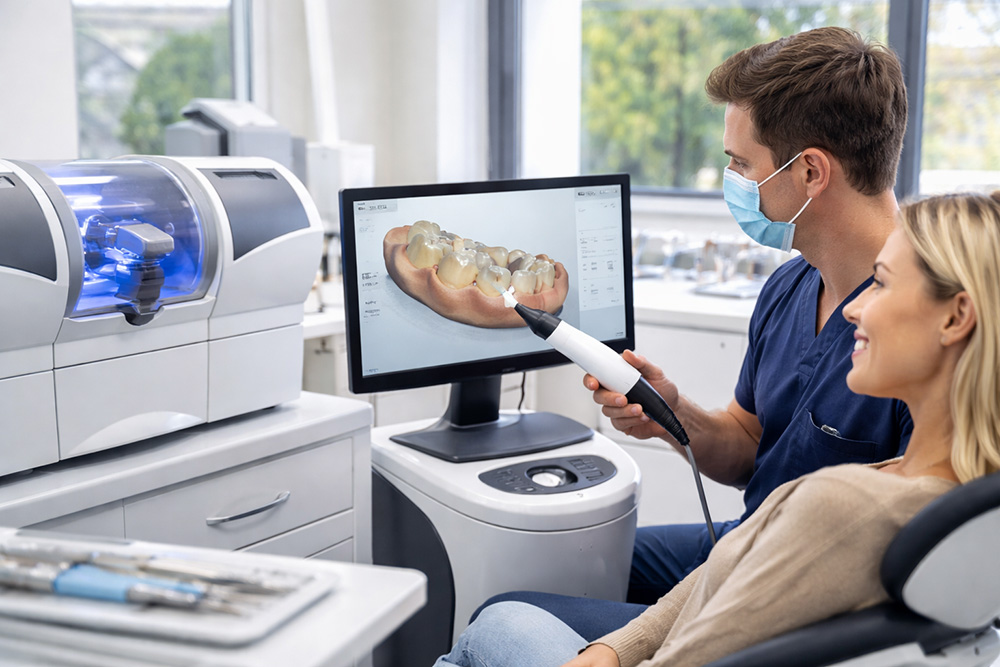
CEREC crowns disrupt this sequence entirely. Digital scans replace impression materials, CAD software replaces manual wax-ups, and in-practice milling produces restorations in hours rather than weeks. For Australian patients—many of whom juggle demanding work schedules or travel significant distances to see a dentist—this efficiency is not a luxury. It is a practical expectation.
From a clinician’s perspective, the benefits extend well beyond speed. Digital impressions offer micron-level accuracy, reducing marginal discrepancies and improving long-term restorative outcomes. In a country where preventive dentistry is highly valued, restorations that preserve tooth structure and minimise future intervention align naturally with best-practice philosophy.
Precision Dentistry in a Digitally Mature Market
Australia’s dental sector is uniquely positioned for digital dentistry adoption. High clinical standards, strong regulatory oversight, and a technologically literate population create fertile ground for innovations like CEREC.
Modern CEREC systems now integrate occlusal analysis, bite simulation, and material selection algorithms that support evidence-based decision-making. This allows dentists to design restorations that are not only aesthetic but biomechanically sound—particularly critical for posterior crowns subjected to high occlusal forces.
As discussions at recent and upcoming 2026 Dental Events increasingly highlight, restorative dentistry is moving away from artisanal variability and toward reproducible digital excellence. CEREC crowns sit squarely at the centre of this shift, blending clinician expertise with machine-level consistency.
CEREC crowns represent a quiet revolution in restorative dentistry, where precision engineering meets immediacy. Using advanced digital scanning and chairside milling, CEREC technology allows a damaged tooth to be restored with a custom ceramic crown in a single appointment, eliminating the need for temporary restorations and multiple visits. Beyond convenience, the true value of CEREC crowns lies in their accuracy: digitally designed margins, high-strength ceramics, and a workflow that reduces human error contribute to restorations that are both durable and highly aesthetic. For patients, CEREC crowns redefine the dental experience—not as a drawn-out process of waiting and uncertainty, but as a seamless, technology-driven solution that respects time while delivering long-term function and natural-looking results.
Patient Experience as a Clinical Outcome
Australian dentistry has progressively redefined success. It is no longer measured solely by radiographs or margins, but by patient experience, understanding, and confidence.
Same-day crowns reduce dental anxiety by eliminating prolonged treatment timelines. Patients leave with a permanent restoration, not a temporary reminder of ongoing dental work. For rural and regional Australians, this can mean fewer days off work and reduced travel costs—factors that directly influence access to care.
Importantly, CEREC crowns also enhance patient education. On-screen design allows dentists to explain preparation choices, occlusal anatomy, and material selection in real time. This transparency builds trust and positions restorative dentistry as a collaborative process rather than a passive procedure.
Materials That Reflect Modern Expectations
Early criticism of chairside crowns often centred on material limitations. That argument is now largely obsolete. Contemporary CEREC systems utilise advanced lithium disilicate and zirconia ceramics that rival, and in some cases exceed, laboratory-fabricated alternatives in strength and longevity.
These materials suit the Australian lifestyle: resilient enough for robust diets, aesthetically refined for high cosmetic expectations, and compatible with minimally invasive preparations. As sustainability becomes an emerging theme within 2026 Dental Events, in-house milling also reduces transport emissions and material waste associated with traditional lab workflows.
Redefining the Dentist–Laboratory Relationship
CEREC crowns do not eliminate dental laboratories; they redefine collaboration. Complex cases, aesthetic layering, and full-arch rehabilitations still benefit from specialist lab expertise. However, routine single-unit restorations can now be managed entirely in-practice, freeing laboratories to focus on high-value prosthetics.
This recalibration enhances efficiency across the profession and allows Australian dentists to exercise greater control over clinical outcomes—an increasingly important consideration in a digitally accountable healthcare environment.
The Future Chapter Is Already Being Written
As Australia looks ahead, the conversation is no longer whether digital dentistry will dominate, but how intelligently it will be integrated. CEREC crowns represent more than a technological upgrade; they symbolise a shift toward immediacy, precision, and patient empowerment.
With digital workflows now a central theme at 2026 Dental Events, it is clear that chairside restorative solutions are shaping the next era of clinical dentistry. For Australian practices committed to excellence, adaptability, and long-term patient relationships, CEREC crowns are not the future—they are the present, refined.